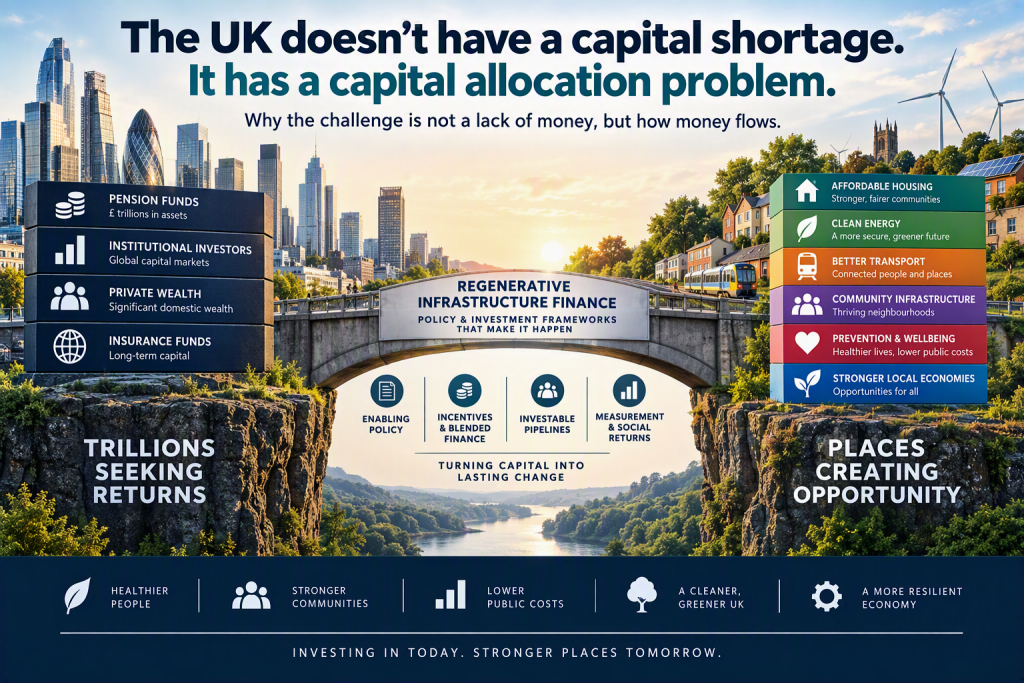
The UK Doesn’t Have a Capital Shortage. It Has a Capital Allocation Problem.
Why the challenge is not a lack of money, but how money flows.
For years, we have been told that the UK’s infrastructure challenges stem from a shortage of money.
There is no money for housing.
- No money for local government.
- No money for community facilities.
- No money for prevention.
- No money for public services.
- No money for infrastructure.
But what if we’re asking the wrong question?
The UK is not short of capital. Pension funds, institutional investors, insurance funds and private wealth collectively hold trillions of pounds in assets. At the same time, our communities face housing shortages, ageing infrastructure, growing demand on public services, widening inequalities and increasing pressure from climate and economic change.
- The issue is not a lack of capital.
- The issue is where that capital flows.
Following the Money
Capital behaves rationally.
Investors seek opportunities that generate reliable financial returns. Buying shares, property, established infrastructure assets or other financial instruments is often easier, less risky and more profitable than investing in affordable housing, community capacity, youth services, preventative health programmes or neighbourhood resilience.
There is nothing inherently wrong with this. The financial system has been designed to reward financial returns.
The problem is that many of the things which underpin long-term prosperity generate social returns rather than immediate financial returns.
- A thriving community centre may reduce loneliness, improve wellbeing and strengthen local resilience.
- A youth programme may reduce future demand on public services.
- Community development can help improve health outcomes, strengthen social networks and support local economic activity.
These benefits are real. They are measurable. They often produce substantial savings elsewhere in the system. However, they rarely produce the type of direct financial return that attracts mainstream investment. As a result, they are frequently left to government to fund.
The Quiet Consequence of Austerity
Over the last decade, government has increasingly become the primary investor in the social infrastructure that underpins long-term prosperity.
By social infrastructure, I mean the assets and capabilities that help communities function and flourish:
- Community hubs
- Youth services
- Local development initiatives
- Volunteering networks
- Preventative health interventions
- Neighbourhood support systems
- Skills and employability programmes
These investments help create healthier communities, stronger local economies and reduced demand on public services.
Yet the capacity of government to fund these activities has steadily weakened.
After more than a decade of austerity and ongoing pressure on local authority finances, many of the institutions responsible for maintaining communities have fewer resources available than the challenges they are expected to address.
At precisely the moment when social infrastructure has become more important, our ability to invest in it has diminished.
The False Choice
This feels particularly relevant as public debate increasingly focuses on difficult spending choices.
Should we spend more on welfare?
- More on defence?
- More on healthcare?
- More on infrastructure?
- More on local government?
These debates matter.
But they are often framed around a single assumption: that public spending is the only resource available. The result is a continual conversation about reallocating increasingly constrained public budgets.
One priority gains. Another loses.One department receives investment. Another faces cuts.
Yet this approach largely ignores a much bigger question.
Why does a country with trillions of pounds of available capital struggle to connect even a small proportion of that wealth with the infrastructure and social foundations that create long-term prosperity?
A Capital Allocation Problem
The challenge facing the UK is not that wealth has disappeared.
The challenge is that our systems have become exceptionally good at creating wealth from assets while becoming far less effective at reinvesting that wealth into the places and conditions that enable prosperity in the first place.
We have built sophisticated mechanisms for:
- Growing investment portfolios
- Expanding asset values
- Generating shareholder returns
- Managing financial risk
But we have relatively few mechanisms that allow capital to flow efficiently into:
- Affordable housing
- Community infrastructure
- Prevention
- Local energy systems
- Place-based regeneration
- Long-term community resilience
This is not a capital shortage. It is a capital allocation problem.
The Case for Regenerative Infrastructure Finance
If markets naturally pursue financial returns, then public policy has a crucial role in shaping the rules, incentives and institutions that determine where capital flows.
Rather than relying exclusively on public spending, government could focus on creating regenerative infrastructure finance frameworks that enable private and institutional capital to participate in long-term place-based investment.
This means building:
Better Policy – Policies that encourage long-term productive investment rather than short-term asset accumulation.
Investable Pipelines – Projects that are structured in ways institutional investors can understand and support.
Blended Finance Models – Approaches that combine public, private and philanthropic capital to reduce risk and unlock larger investment flows.
Outcome-Based Investment – Mechanisms that recognise and reward social value alongside financial value.
Place-Based Investment Funds – Vehicles capable of attracting capital into communities, local infrastructure and neighbourhood renewal.
The objective is not to replace public investment. It is to create new pathways through which capital can contribute to the physical and social infrastructure upon which future prosperity depends.
Reconnecting Wealth and Place
At All About The Place, we spend much of our time exploring the relationship between people, place, systems and outcomes.
Again and again, we encounter the same challenge. The things that create thriving places are often the things that struggle to attract investment. Yet those same investments frequently generate the greatest long-term value.
Perhaps the next phase of economic development should not be focused solely on creating more wealth. Perhaps it should focus on creating better mechanisms to reconnect existing wealth with the places, people and infrastructure that make prosperity possible.
The capital already exists.
The question is whether we have the political will, institutional imagination and policy tools needed to ensure that it flows to where it can create the greatest long-term benefit.
Because the UK doesn’t have a capital shortage. It has a capital allocation problem.
All About The Place believes that stronger communities, healthier lives and more resilient local economies are not simply social outcomes. They are investments in the foundations upon which future prosperity depends.