Blog
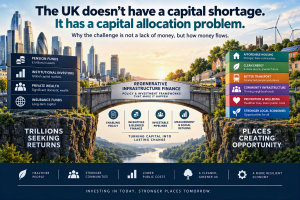
The UK Doesn’t Have a Capital Shortage. It Has a Capital Allocation Problem.
Why the challenge is not a lack of money, but how money flows. For years, we have been told that the UK’s infrastructure challenges stem from a shortage of money. There is no money for housing. But what if we’re asking the wrong question? The UK is not short of capital. Pension funds, institutional investors, insurance funds and private wealth

From Youth Guarantee to Neighbourhood Opportunity: What If We Joined the Dots?
Something interesting may be happening in public policy. Across employment, health, skills, devolution and public service reform, we are beginning to see a common idea emerge: Place matters. The government’s Youth Guarantee aims to ensure young people can access further learning, help into employment or an apprenticeship. Importantly, some of its development is already happening through local trailblazer areas that

When Progress Stops Paying: AI and the Loss of Economic Breathing Space
Historically, businesses have sought to discover what the market will bear. Increasingly, technology offers the possibility of discovering what each individual will bear. That distinction matters. Many years ago, I was involved in building a business with a colleague. As we worked through the practical challenges of turning an idea into a viable commercial venture, I asked what I thought

What We’ve Learned So Far: The Reality of Implementing Asset-Based Community Development
Asset-Based Community Development (ABCD) continues to gain attention as organisations and systems look for more effective ways to address persistent inequalities and improve health and wellbeing outcomes. Its appeal is easy to understand. ABCD starts from a simple but important observation: communities are not defined solely by their needs. Every place contains strengths, relationships, knowledge, skills, organisations and networks that

Why Place Must Be at the Heart of Development
Today’s intervention from Andy Burnham adds renewed energy to a long-standing but increasingly urgent conversation: who should shape the future of our places? At its core, the argument is simple. Decisions about development — from housing and infrastructure to skills and economic growth — are most effective when they are rooted in the places they are intended to serve. Local

Pride in Place: From Participation to Shared Power
What it will take to make community leadership real At All About The Place, we believe people and places thrive when communities are not just involved in change, but help shape, lead and sustain it. A moment of opportunity for place-based working or many working in places, there is a growing recognition that how we design and deliver change matters

Placemaking in 2026: Why Community Co-Design Is No Longer Optional
As 2026 begins, there is a growing sense that placemaking in the UK is at a crossroads. The pressures are obvious. Public services are stretched thin. Inequality is deeply entrenched. Too many strategies look impressive on paper yet fail to change how places actually feel or function for the people living there. What’s less often acknowledged is why this keeps

Going to Where the Work Is Needed: Rethinking How We Deliver Prevention
Across the country, there is growing investment in wellbeing hubs — centralised spaces designed to bring services together and offer a visible access point for health, wellbeing and prevention. This direction of travel aligns with wider NHS and Integrated Care System (ICS) ambitions to simplify access, reduce fragmentation, and support earlier intervention. In many contexts, these hubs have clear benefits.

The Role of Small-Medium Enterprises in Asset-Based Community Development in the UK
In recent years, Asset-Based Community Development (ABCD) has gained increasing attention across the UK as an alternative to deficit-led models of community support. Rather than starting with what communities lack, ABCD focuses on recognising, connecting and strengthening the assets that already exist — people, relationships, skills, organisations and local enterprise. Within this context, small and medium enterprises (SMEs) play a
Recent Comments